Vented attic with many eave bays
Insulation packages follow area, but baffle cartons follow bay count and sealant follows penetrations. The accessory order remains substantial.
Home & Construction
Preserve zone measurements and round insulation, baffles, sealant, and depth markers independently instead of multiplying one generic factor through every item.
INSULATION MULTI-MATERIAL TAKEOFF
Measured zones establish net area after one explicit exclusion. Insulation packages receive the entered ordering allowance; ventilation baffles, air sealant, and depth markers retain their own counts and yields.
EDITORIAL FIELD GUIDE
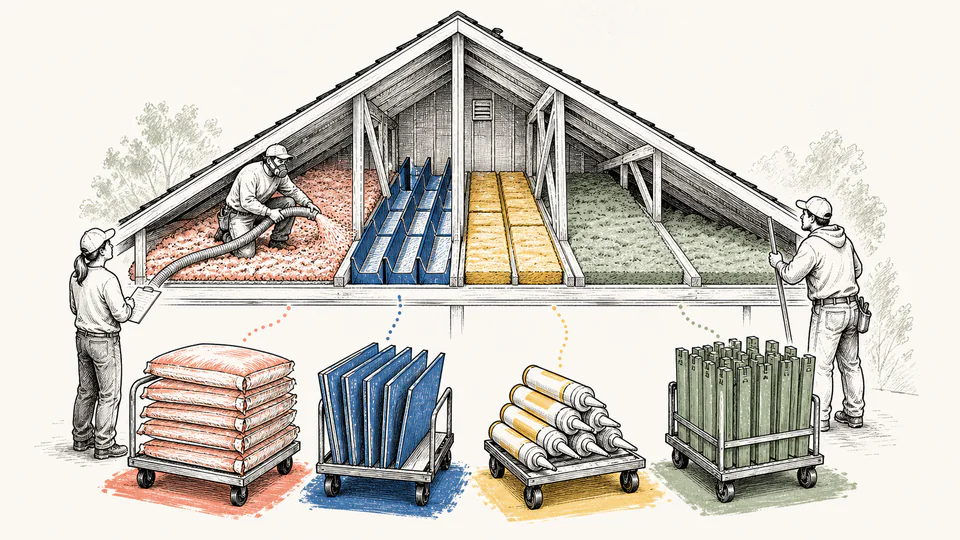
The crew scene distinguishes thermal material from ventilation and air-sealing accessories. The ledger preserves each measured basis and rounds packages, baffle cartons, sealant tubes, and depth markers independently.
| Material family | Measured basis | Allowance or yield | Unrounded demand | Order quantity | Residual / boundary |
|---|
How to use
Takeoff fundamentals
Calculation method
Zone areas sum to gross area; exclusions are deducted once and the insulation allowance is applied once. Thermal material divides by package coverage. Baffles divide by carton count, sealant divides measured joint length by tube yield, and depth markers divide net area by the entered planning area per marker.
Ventilation boundary
Rafter vents or baffles keep soffit-to-attic airflow open where that ventilation path is required. Count actual eave bays and detail dams, blocking, and clearances separately. Extra insulation packages do not compensate for blocked ventilation.
Air-seal boundary
Published tube yield changes with bead diameter. High-temperature penetrations, chimneys, flues, wiring, and large gaps may require different materials or backing. One generic sealant length cannot be applied indiscriminately.
Verification boundary
Marker spacing is an entered planning rule, not a universal code. Retain product bags, coverage labels, depth readings, density or bag-count records, photographs, and gap/compression observations required by the governing program or specification.
Detailed calculation process
The current result cards and purchase-family ledger above provide the final reconciliation.
Result interpretation
Whole package, carton, and tube counts support ordering. The nominal insulation surplus is label coverage beyond the order area; it cannot correct gaps, compression, low density, wind washing, wet material, missing air control, or thermal bridges.
Decision analysis
A large insulation surplus can signal package rounding or a mismatched coverage line. Extra baffles may reflect carton size; extra sealant may reflect bead assumptions. Do not cut all items by one percentage because their residuals have different causes.
Evidence and data lineage
Keep zone names and dimensions, exclusions, assembly location, climate and code target, product manufacturer and SKU, R-value, depth, density, package coverage chart, allowance rationale, eave-bay count, baffle model, sealant type and bead size, joint-length sketch, marker rule, purchased quantities, installed bag count, depth readings, and corrective work.
Limits and exclusions
Key terminology
Worked decision cases
Insulation packages follow area, but baffle cartons follow bay count and sealant follows penetrations. The accessory order remains substantial.
The same nominal area may require no attic baffles but different netting, dense-pack verification, fire details, and product coverage. Run a project-specific takeoff.
Authoritative basis
Check for vermiculite, moisture, combustion appliances, hot flues, recessed lights, damaged wiring, and unsafe walking surfaces before disturbing an attic. Product quantity never authorizes unsafe work.
Separate records expose omitted areas and allow unlike assemblies to be calculated independently.
Follow the product takeoff method and assembly design; framing remains a thermal bridge even when it is not filled.
No. Those families use counts and linear yields rather than insulation area.
A larger sealant bead consumes more volume per foot and reduces the length served by one tube.
Requirements vary by product, specification, program, and jurisdiction; enter the documented project rule.
Only if the product, assembly, installed depth, density, and coverage instructions for that use are confirmed.