Accessible attic top-up
Loose-fill has lower labor hours and a compatible coverage chart. The cost result supports selection after air sealing and ventilation work are separately scoped.
Home & Construction
Hold area and target R-value constant while preserving each option's label coverage, allowance, package price, productivity, and labor rate.
INSULATION OPTION DECISION
Both options use the same measured area and target R-value, but keep their own label coverage, ordering allowance, package price, installation productivity, and labor rate. Cost and labor leaders are reported separately.
EDITORIAL FIELD GUIDE
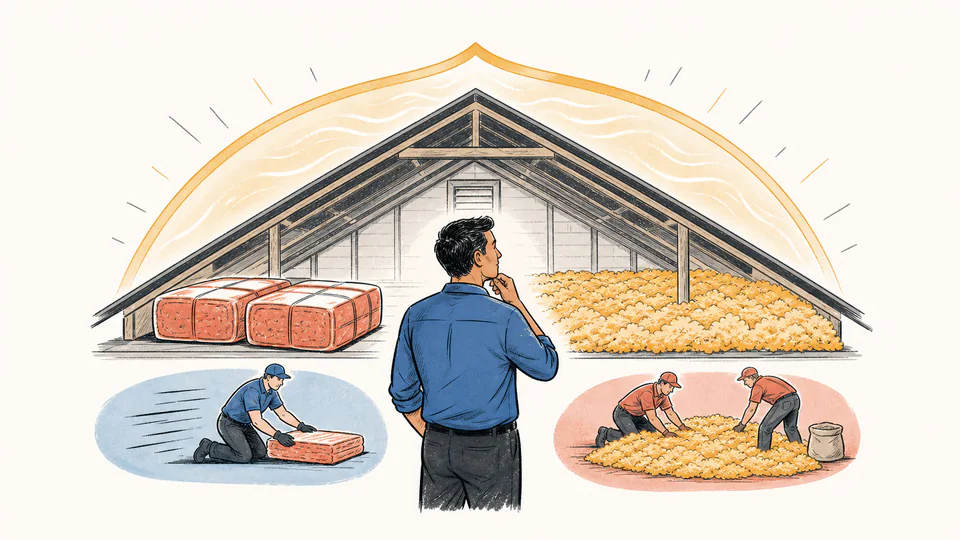
The field illustration keeps both assemblies tied to one thermal target. The reconciliation then separates package rounding, material price, labor hours, and installed cost so a cheaper package is not mistaken for a cheaper plan.
| Metric | Option A | Option B | B minus A | Decision boundary |
|---|
How to use
Comparison fundamentals
Calculation method
For each option, measured area receives its own allowance and is divided by that option's coverage per package. Packages round upward because partial packages cannot satisfy the order. Labor hours use measured area divided by productivity, then multiply by labor rate. The two cost totals share the same scope but preserve different assumptions.
Thermal equivalence
Do not compare a low-depth package yield with another product's high-R yield. R-value depends on material, thickness, and sometimes installed density. If one option is continuous insulation and the other is cavity insulation, code and assembly effects may differ even when the nominal R-value is equal.
Labor evidence
Open attic blowing, dense-pack wall work, fitted batts, rigid boards, and spray products require different equipment and preparation. Use an estimate, crew record, or contractor quote that matches the location, obstructions, setup, and verification included in the comparison.
Decision boundary
Material availability, air-control continuity, vapor behavior, fire protection, ventilation, compression, settlement, embodied impacts, future access, and installer qualifications can govern the decision. Use this page to reconcile arithmetic after the assembly and product choices are technically acceptable.
Detailed calculation process
The current result cards and scenario ledger above provide the final reconciliation.
Result interpretation
A negative B-minus-A cost means B is cheaper; a positive value means A is cheaper. The labor difference uses the same sign convention. Package surplus is nominal label coverage beyond the order area and is not proof of installed thermal continuity.
Professional decision
A large difference may come from package rounding, a mismatched target-R label line, a quote that excludes setup, or productivity recorded under unlike access. Reconcile those drivers with the supplier and installer instead of treating the calculator as an automatic award recommendation.
Evidence and data lineage
Keep zone measurements, assembly location, target R-value, product manufacturer and SKU, coverage chart revision, depth and density, allowance rationale, package price date, labor inclusions, productivity source, crew conditions, setup and cleanup scope, ventilation plan, air-sealing scope, installer qualification, and field acceptance records.
Limits and exclusions
Key terminology
Worked decision cases
Loose-fill has lower labor hours and a compatible coverage chart. The cost result supports selection after air sealing and ventilation work are separately scoped.
A lower material total does not control when the method cannot reach required density or would damage finishes. Technical feasibility is resolved before price.
Authoritative basis
Use the current package label and manufacturer instructions for the selected target and assembly. Do not choose an insulation plan on calculated cost alone when moisture, fire, ventilation, combustion safety, or code conditions remain unresolved.
Otherwise package coverage and thermal intent are not comparable.
Use the exact product coverage or quantity instruction whenever available; R per inch alone does not establish package yield.
Purchase quantities are discrete, so the supplier invoice reflects whole packages rather than an unrounded fraction.
Not necessarily. Setup, equipment, cure, access, inspections, and other trades may control elapsed duration.
Keep gross project cost and incentive eligibility separate unless the rebate amount and requirements are verified.
Only after a qualified assessment confirms that both assemblies are acceptable for the location, moisture strategy, fire protection, and code requirements.