Live calculation visualCurrent entered assumptions
Home & Construction
Roof Shingle Coverage Calculator
Keep field shingles, starter strips, and ridge caps on their own coverage bases so accessory packages are not hidden in a single square count.
PRODUCT-YIELD ROOF TAKEOFF
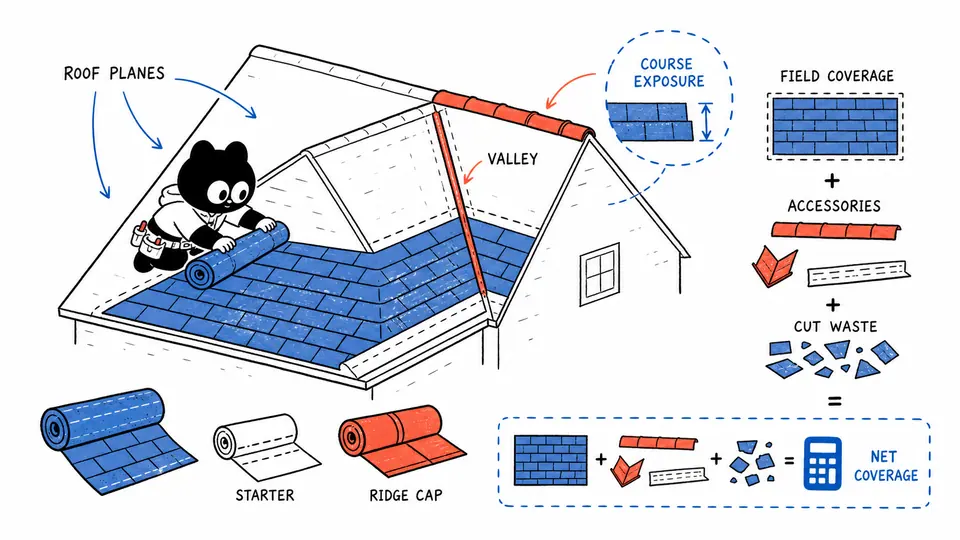
Count field shingles, starter, and ridge cap as different coverage systems
Roofing estimators can paste measured plane areas, apply a field-waste allowance, and round field, starter, and ridge packages independently using the selected product yields.
Total separate packages—
Field bundles—
Ridge-cap bundles—
Starter bundles—
Measured field area—
Field package overage—
COURSE-AND-ACCESSORY MAP
See measured planes turn into three non-interchangeable package stacks
Plane tiles feed the field stack; linear ridge and starter scopes feed their own stacks. The chart exposes package rounding instead of combining unlike units.
| Coverage family | Measured scope | Allowance/yield | Whole packages | Residual coverage |
|---|
How to use
Count field shingles, starter, and ridge cap as different coverage systems
- Measure each roof plane separately and paste only positive areas.
- Confirm whether valleys or specialty membranes reduce or add field-shingle scope.
- Enter waste based on cut pattern, handling, and product instructions.
- Copy field bundle coverage from the selected product and exposure.
- Measure ridge/hip and starter eave/rake lengths on the same drawing revision.
- Enter accessory package yields, review separate rounding, and verify a panel-by-panel field plan before ordering.
ROOF-COVERAGE FUNDAMENTALS
Treat field, starter, and ridge products as separate coverage systems
- Field coverage
- Exposed roof-plane area covered by standard shingle courses.
- Exposure
- Visible course height that controls installed coverage.
- Starter strip
- Edge course designed for sealing and first-course support.
- Ridge cap
- Accessory covering hips and ridges on a linear-foot basis.
- Package rounding
- Each purchasable family rounds up independently.
CALCULATION METHOD
Round each product family after its own installed yield
Sum measured roof planes, apply field waste, divide by field-bundle coverage, and calculate starter and ridge packages independently from their linear installed yields.
PRODUCT YIELD
Nominal squares can conceal product yield
Three bundles per square is not universal. Coverage depends on product, exposure, starter method, and accessory packaging.
ROOF COMPLEXITY
Waste is geometric, not a magic percentage
Valleys, dormers, short courses, color blending, damage, and minimum reusable offcuts drive allowance. A cut plan is better evidence than habit.
ACCESSORY SEPARATION
Accessories cannot be borrowed from field count
Cutting field shingles for ridge or starter may violate product instructions or warranty terms and changes actual yield.
Detailed calculation process
Coverage and package ledger
The model sums measured planes for field scope, applies field waste once, and divides by field coverage per bundle. Ridge and starter use linear yields; they are not converted into field squares.
Afield = Σ plane areasAorder = Afield×(1+waste%)field bundles = ceil(Aorder/field bundle coverage)ridge bundles = ceil(ridge length/ridge yield); starter bundles = ceil(starter length/starter yield)
| Symbol | Meaning | Unit |
|---|---|---|
| Afield | Measured field area | ft² |
| Aorder | Field area including allowance | ft² |
| waste% | Field allowance | dimensionless |
| coverage | Installed yield per field bundle | ft²/bundle |
| ridge yield | Linear hip/ridge coverage | ft/bundle |
| starter yield | Linear edge coverage | ft/bundle |
- Field planes: 900 + 900 = 1,800 ft².
- Field order scope: 1,800×1.10 = 1,980 ft².
- Field bundles: ceil(1,980/33.3) = 60.
- Ridge: ceil(60/25) = 3 bundles.
- Starter: ceil(140/100) = 2 bundles.
- Total separate packages = 65; field purchased coverage minus order scope reconciles overage.
The live result cards and exact ledger above provide the final reconciliation for the current inputs.
Result interpretation
Package total is a summary, not an interchangeable stockpile
Total packages is a logistics count, not a claim that all bundles are interchangeable. Field overage is area arithmetic; its shape may not produce reusable shingles. A very high utilization ratio can still be risky on a cut-up roof.
Visual interpretation
See measured planes turn into three non-interchangeable package stacks
Area tiles and linear accessory rails deliberately use different shapes. Only field inputs change the field stack; ridge and starter lengths move their own markers. The visual simplifies actual plane geometry and must not replace a layout drawing.
EVIDENCE FOR THIS MODEL
Retain every plane record, edge length, ridge length, and package yield
Retain measured plane schedule, pitch and scale check, overhang convention, valley method, selected shingle data sheet, exposure, lot/color blending plan, starter and ridge product yields, waste rationale, damaged-package policy, and installer confirmation.
SCOPE AND LIMITATIONS
What package counts omit from a complete roof order
- No cutting optimization or course layout is performed.
- Valley, ice-barrier, flashing, ventilation, underlayment, nails, and sealants are outside this page.
- Mixed products or exposures require separate calculations.
- Package overage does not guarantee returnable or reusable stock.
KEY TERMINOLOGY
Field, starter, ridge, and yield terminology
- Plane area
- Measured sloped surface of one roof face.
- Exposure
- Installed visible height of a shingle course.
- Field bundle
- Package intended for main roof planes.
- Starter yield
- Linear edge covered by one starter package.
- Ridge yield
- Linear hip/ridge covered by one cap package.
- Overage
- Purchased coverage beyond calculated order scope.
PRACTICAL DECISIONS
Simple gable versus Dormered hip roof
Simple gable
Measured planes with one straight ridge may support a low documented waste allowance after checking rake and eave starts.
Dormered hip roof
Create separate plane records and a detailed valley/hip layout; a single waste percentage may understate short-course losses.
AUTHORITATIVE BASIS
References for product-yield roof takeoff
Important note
Do not order solely from nominal squares. Verify product-specific installed coverage, accessory system, lot availability, and roof geometry with the manufacturer and installer.
Frequently asked questions
Why paste several plane areas?
Separate records preserve the measured takeoff and make omissions easier to audit.
Is waste applied to starter and ridge?
Not in this model; enter yields or allowances that match those products.
Can I assume 33.3 ft² per bundle?
Only when the selected product data supports that installed coverage.
Why can 1.98 squares need 60 bundles?
It is 19.8 squares; package count uses area divided by product yield and rounds up.
Can leftover field shingles become ridge caps?
Only if the approved system and manufacturer instructions explicitly allow it.
Does this include underlayment?
No. Use the quantity page for a broader purchase list.