Live calculation visualCurrent entered assumptions
Home & Construction
Roof Shingle Project Schedule Calculator
Separate labor-driven roofing production from inspection and weather delays, and identify the planned dry-in milestone.
ROOF REPLACEMENT PRODUCTION PLAN
Schedule dry-in separately from final completion
Roofing contractors, estimators, and owners can convert a measured roof scope into labor-hours, productive crew-days, a planned dry-in milestone, and calendar duration. Production rates are user evidence; inspection and weather remain explicit delays rather than hidden labor.
Planned calendar duration—
Planned dry-in day—
Total labor-hours—
Productive crew-days—
Deck repair allowance—
Daily crew capacity—
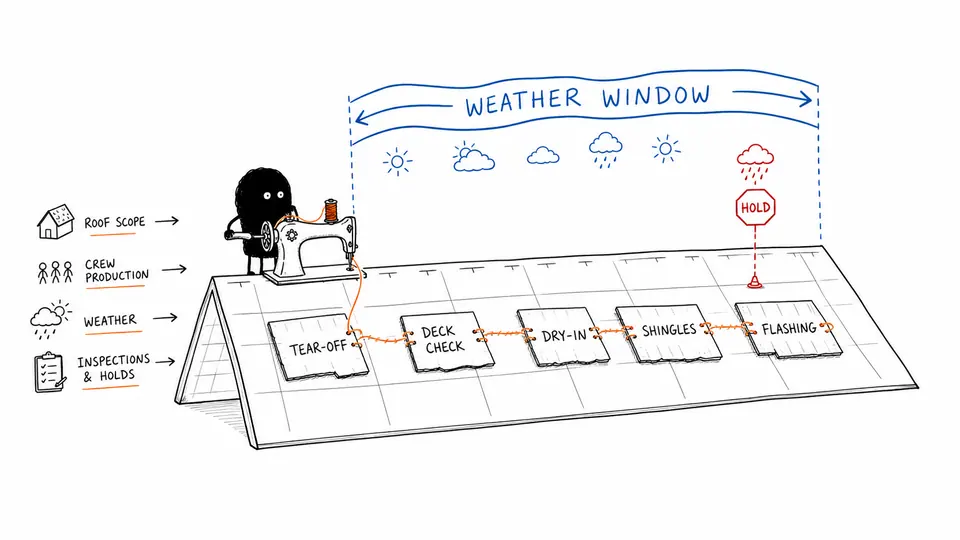
CRITICAL ROOFING SEQUENCE
See labor phases, dry-in, and non-working holds on one timeline
The live timeline uses phase labor converted through crew capacity; inspection and weather blocks occupy calendar time without being mislabeled as work.
| Phase | Measured basis | Labor-hours | Crew-days | Calendar effect |
|---|
How to use
Schedule dry-in separately from final completion
- Measure sloped roof-plane area from current drawings or a verified takeoff.
- Count tear-off layers and document whether disposal handling is inside the productivity rate.
- Estimate deck repair area from inspection evidence, not a universal percentage.
- Enter crew size, paid workday, and phase-specific observed productivity.
- Add flashing and cleanup labor that does not scale cleanly with area.
- Enter inspection and weather no-work days separately, then review dry-in before total finish.
ROOF PRODUCTION FUNDAMENTALS
Separate dry-in, labor demand, crew capacity, and hold days
- Dry-in
- Point at which the approved temporary or permanent water-shedding layers protect the deck.
- Labor-hour
- One worker for one hour; four workers for one hour consume four labor-hours.
- Crew-day capacity
- Crew size multiplied by productive hours per workday.
- Hold day
- Calendar time in which modeled production does not advance.
- Production rate
- Completed scope per labor-hour under a defined crew method and access condition.
CALCULATION METHOD
Build phase labor first and elapsed calendar second
Calculate tear-off, repair, dry-in, field installation, flashing, and cleanup labor independently. Divide labor by usable crew capacity, then add inspection and weather holds without converting delays into worker-hours.
WEATHER EXPOSURE
Dry-in governs exposure risk
A short total duration can still leave the deck exposed too long. Review tear-off, repair, and dry-in as a continuous protection sequence and phase the roof when the weather window is shorter.
PRODUCTION EVIDENCE
Productivity must match scope
A tear-off rate that excludes ground handling cannot be combined with cleanup hours that also exclude disposal. Freeze access, lift, staging, layer count, and crew method before transferring a rate.
CALENDAR LOGIC
Calendar buffers are not labor
Weather and inspection waits move finish dates but do not create worker-hours. Keeping them separate makes overtime, added crew, and resequencing decisions auditable.
Detailed calculation process
Roofing phase schedule ledger
Every phase develops its own labor demand. The model sums those hours, divides once by daily crew capacity, and then adds declared non-working delays. It does not inflate labor merely because a project waits for inspection or weather.
Htotal = A×layers/Ptear + A×repair%/Prepair + A/Pdry + A/Pshingle + Hflash + Hcleanproductive crew-days = Htotal/(crew×hours/day)planned dry-in day = (Htear + Hrepair + Hdry)/(crew×hours/day) + inspection holdcalendar duration = productive crew-days + inspection hold + weather delay
| Symbol | Meaning | Unit |
|---|---|---|
| A | Measured roof-plane area | ft² |
| P | Phase productivity | ft²/labor-hour |
| H | Labor demand | labor-hours |
| repair% | Deck area fraction repaired | dimensionless |
| crew | Workers assigned | people |
| hold | Declared no-production time | days |
- Tear-off: 2,400×1/60 = 40.00 labor-hours.
- Deck repair: 2,400×10%/20 = 12.00 labor-hours.
- Dry-in: 2,400/80 = 30.00 labor-hours.
- Shingles plus details: 2,400/25 + 12 + 8 = 116.00 labor-hours.
- Total 198.00 labor-hours ÷ 32 labor-hours/day = 6.1875 productive crew-days.
- Add 1 inspection day and 2 weather days: 9.1875 calendar days; phase hours reconcile to the total.
The live result cards and exact ledger above provide the final reconciliation for the current inputs.
Result interpretation
Dry-in day and final completion answer different risk questions
Calendar duration is the primary planning output, while planned dry-in day is the risk checkpoint. A zero repair allowance is a scenario, not proof of sound decking. Decimal crew-days represent capacity demand; round a contractual date only after applying working-calendar rules.
Visual interpretation
See labor phases, dry-in, and non-working holds on one timeline
Phase widths represent crew-days; red hold blocks are elapsed time rather than production. The dry-in marker moves when tear-off, repair, dry-in, crew capacity, or inspection hold changes. A linear timeline can understate uncertainty in hidden repair scope.
EVIDENCE FOR THIS MODEL
Retain scope, crew method, hidden-condition allowance, and weather assumptions
Retain roof takeoff revision, layer count, moisture or deck inspection, crew composition, timecards from comparable work, access and disposal method, manufacturer sequence, permit/inspection timing, local forecast window, and who owns temporary weather protection.
SCOPE AND LIMITATIONS
What this production model cannot promise
- No fall-protection, heat, rescue, material-lift, or site safety plan is created.
- Hidden deck damage and flashing reconstruction can invalidate the production rates.
- Parallel work, overtime, cure times, delivery, and trade interference are not modeled.
- Weather days are entered scenarios, not meteorological forecasts.
KEY TERMINOLOGY
Roof replacement scheduling terms
- Tear-off
- Removal of existing roof-covering layers.
- Deck repair
- Replacement or correction of the roof substrate.
- Dry-in
- Weather-protection milestone before finish covering is complete.
- Critical sequence
- Dependent phases controlling the modeled finish.
- Crew-day
- One crew working one entered workday.
- Productivity basis
- Scope and conditions represented by a production rate.
PRACTICAL DECISIONS
Occupied reroof versus Known deck replacement
Occupied reroof
Prioritize a credible dry-in milestone and limit daily tear-off to the area that can be protected before shutdown.
Known deck replacement
Replace the percentage allowance with a measured repair scope and a matching carpentry rate before promising completion.
AUTHORITATIVE BASIS
References for roof replacement production plan
Important note
Do not rely on this schedule alone for contractual dates, fall protection, emergency weather response, or sequencing that affects occupied spaces.
Frequently asked questions
Why can calendar days exceed crew-days?
Inspection and weather are elapsed delays, not productive labor.
Should I round every phase up to a day?
Not in the arithmetic; rounding each phase can overstate duration. Apply actual shift and mobilization rules afterward.
Can more workers always shorten the roof?
No. Congestion, lift limits, safety zones, and trade handoffs can cap usable crew size.
What if no deck damage is visible?
Use an evidence-based allowance or scenario and preserve a contingency; concealed conditions remain unknown.
Is dry-in the same as completion?
No. Shingles, flashing, ventilation details, cleanup, and inspection may remain.
Can this replace a contractor schedule?
No. It is a transparent planning model that a contractor must reconcile with means, methods, and calendar.