Live calculation visualCurrent entered assumptions
Home & Construction
Roof Shingle Scenario Comparison Calculator
Evaluate each roofing option with its own waste, bundle coverage, price, labor, productivity, maintenance, and service-life assumptions.
ROOF SYSTEM TRADE-OFF
Compare eligible roof systems beyond first price
Owners and estimators can hold roof scope constant while giving each shingle option its own waste, package yield, price, labor, productivity, service-life, and maintenance assumptions. The cost-per-year result is explicitly undiscounted.
Lower planning cost/year—
Lower installed cost—
Shorter crew duration—
Option A installed—
Option B installed—
B − A cost/year—
MULTI-CRITERIA ROOF DECISION
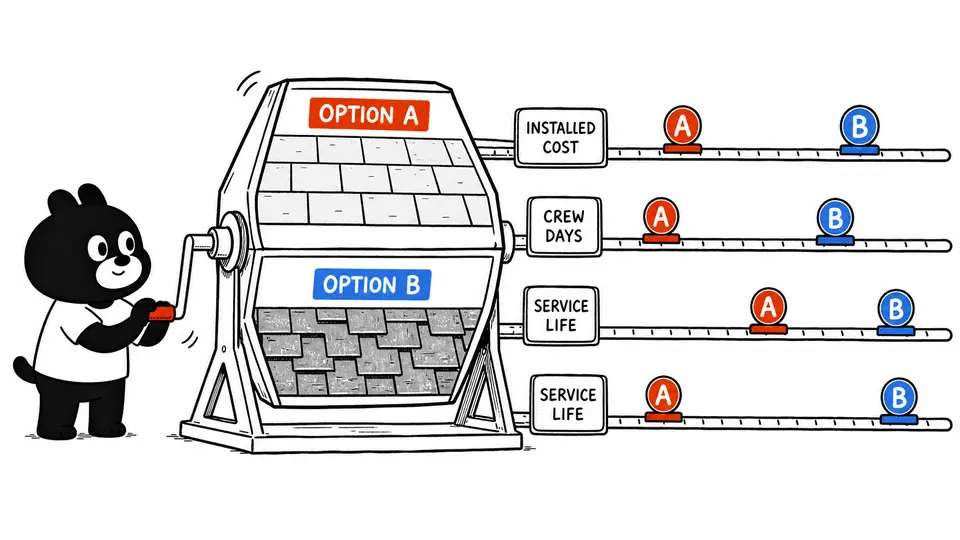
Keep cost, time, and assumed life on separate comparison rails
Two roof systems receive the same measured area but retain separate package rounding and service assumptions. Eligibility and evidence remain visible beside price.
| Metric | Option A | Option B | B − A | Decision use |
|---|
How to use
Compare eligible roof systems beyond first price
- Freeze one measured roof scope and tear-off basis.
- Enter each product’s installed bundle coverage and waste separately.
- Use matched labor scope and crew-production definitions.
- Support service-life and maintenance values with actual product and site evidence.
- Review installed cost and crew days before the undiscounted annualized figure.
- Reject false equivalence and obtain present-value analysis when financing or timing matters.
ROOF-SYSTEM COMPARISON
Keep scope, yield, installed cost, production, and service-life evidence visible
- Common scope
- Geometry and tear-off held constant.
- Package yield
- Installed area supplied by one bundle.
- Installed cost
- Field packages, entered labor, and common tear-off only.
- Service-life assumption
- Planning horizon, not a warranty prediction.
- Undiscounted annualization
- Life total divided by years without time value of money.
CALCULATION METHOD
Compare two eligible systems on independent assumptions
Calculate each option with its own yield, waste, prices, labor, crew capacity, and supported service life. Report cost, duration, and undiscounted cost per year without merging them into a false universal score.
SERVICE-LIFE EVIDENCE
Service life is evidence-sensitive
Climate, ventilation, slope, color, installation, maintenance, storms, and repairs can dominate nominal product category.
WARRANTY BOUNDARY
Warranty is not expected life
Coverage, exclusions, transfer, labor, proration, registration, and workmanship terms must be read separately.
ECONOMIC METHOD
Use present value for capital decisions
Escalation, discount rate, replacement timing, salvage, tax, and financing require a true life-cycle cost model.
Detailed calculation process
Option A versus B reconciliation
Each option rounds its own bundle count, calculates cost and duration independently, then spreads installed plus nominal maintenance cost across its assumed life. The page never lets lower first cost override unsupported eligibility.
bundles = ceil(A×(1+waste%)/coverage)installed = bundles×price + A/100×labor + A/100×tear-offcrew-days = order squares/productivityplanning cost/year = (installed + annual maintenance×years)/years
| Symbol | Meaning | Unit |
|---|---|---|
| A | Common roof area | ft² |
| coverage | Product installed yield | ft²/bundle |
| years | Assumed service horizon | years |
| productivity | Order squares per crew-day | squares/day |
| installed | Modeled first cost | $ |
| annualized | Undiscounted planning cost/year | $/year |
- A uses 67 bundles; B uses 66 bundles after separate rounding.
- A installed cost = 67×$36 + 20×$170 + 20×$70 = $7,212.
- B installed cost = 66×$48 + 20×$190 + 20×$70 = $8,368.
- A life total = $7,212 + $80×20 = $8,812; $8,812/20 = $440.60/year.
- B life total = $8,368 + $55×30 = $10,018; $10,018/30 = $333.93/year.
- B has the lower default planning cost/year; this reconciles only the entered assumptions.
The live result cards and exact ledger above provide the final reconciliation for the current inputs.
Result interpretation
Cost per year is a screen, not the final roofing decision
Lower installed cost, faster work, and lower undiscounted cost/year can point to different options. A negative B−A value favors B for that metric. Equal arithmetic does not prove equal wind rating, fire classification, appearance, warranty, or assembly suitability.
Visual interpretation
Keep cost, time, and assumed life on separate comparison rails
Each rail has its own unit; bar lengths are normalized within a metric and cannot be compared across rails. Live inputs update bundle steps, cost stacks, duration, and life markers. A long assumed life can make cost/year look attractive without making the evidence stronger.
EVIDENCE FOR THIS MODEL
Retain product, labor, warranty, and life evidence for each option
Retain proposal scope, product and accessory data, installed coverage, waste takeoff, labor inclusions, crew history, warranty documents, ventilation and deck condition, maintenance records, climate exposure, service-life basis, price date, and excluded costs.
SCOPE AND LIMITATIONS
Factors excluded from the two-system screen
- No discounting, inflation, financing, salvage, tax, or replacement interruption.
- No warranty claim probability or storm-loss model.
- Common tear-off excludes option-specific deck or accessory changes.
- Only systems permitted for the actual roof may be compared.
KEY TERMINOLOGY
Roof-system comparison and life-cycle terms
- First cost
- Modeled installed expenditure now.
- Life total
- Installed plus nominal maintenance over entered years.
- Annualized screen
- Undiscounted life total divided by years.
- Matched scope
- Same included work across options.
- Eligibility
- Whether a system is permitted and suitable.
- Cost difference
- Option B minus Option A.
PRACTICAL DECISIONS
Low first-cost bid versus Long-life premium system
Low first-cost bid
Confirm coverage, accessories, tear-off, ventilation, workmanship, and exclusions before accepting a price lead.
Long-life premium system
Run a present-value study if service horizon and replacement timing drive the decision.
AUTHORITATIVE BASIS
References for roof system trade-off
Important note
Do not choose a roofing system from cost/year alone. Confirm assembly eligibility, manufacturer instructions, code, warranty, installer scope, and roof-specific risk.
Frequently asked questions
Why is the result called undiscounted?
It does not value money at different dates.
Does a 30-year shingle last exactly 30 years?
No. Enter a supported planning assumption, not marketing shorthand.
Can the cheaper option be slower?
Yes; package, labor, and productivity inputs are independent.
Should waste be identical?
Only when geometry and installation details make the assumption comparable.
Are warranties compared?
No; read actual terms and exclusions separately.
Which output is final?
The decision must combine eligibility, evidence, installed cost, schedule, and a properly chosen economic method.