Measurement synchrony
Batching, belt loading, speed, and power fluctuate; mismatched averaging windows create false residuals.
Engineering
Separate vertical and horizontal material work from no-load baseline and motor input, then calculate overall and incremental loaded efficiency with an unaccounted power residual.
CONVEYOR ENERGY RECONCILIATION
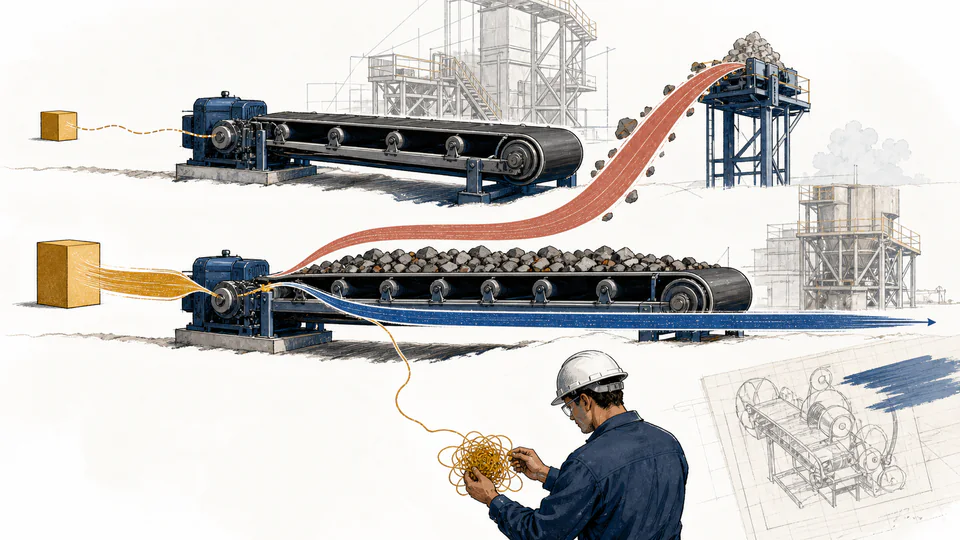
A conveyor can consume substantial power before material is added. This calculator separates measured no-load power from loaded motor input, calculates the power associated with lifting material and overcoming an entered horizontal material resistance, and leaves an unaccounted loaded residual. It reports both overall material-work efficiency and an incremental ratio after the no-load baseline.
CONVEYOR ENERGY RECONCILIATION
Use the residual to investigate measurement alignment, boundary definitions, load-dependent belt/idler losses, skirt drag, spillage, maintenance condition, and drive behavior. Do not interpret low overall efficiency as automatically avoidable because no-load motion is essential to transport.
| Power balance item | Measurement or flow | Comparison basis | Power or residual | Evidence meaning |
|---|
CURRENT CALCULATION PROCESS
Plift = mdot g H; Phorizontal = Fmaterial v; etaOverall=(Plift+Phorizontal)/Pmotor; etaIncremental=(Plift+Phorizontal)/(Pmotor-Pno-load)
The page uses synchronized loaded flow, speed, and power. No-load input remains a separate measured baseline, while attributed material work is calculated explicitly and any difference remains visible as residual rather than being forced into efficiency.
| Input / symbol | Engineering meaning and unit | Current value |
|---|---|---|
| massFlowTph | Measured material flow (t/h) — Synchronized with loaded power | 480 |
| liftM | Vertical lift (m) — Net material elevation gain | 18 |
| beltSpeed | Measured belt speed (m/s) — Same interval as loaded power | 2.6 |
| horizontalResistanceN | Attributed horizontal material resistance (N) — Documented material-related force component | 9000 |
| motorInputKw | Loaded motor input (kW) — Electrical input for defined drive boundary | 72 |
| noLoadPowerKw | Measured no-load input (kW) — Empty belt at comparable speed and condition | 18 |
Intermediate values remain unrounded until display formatting.
HOW TO USE THIS MODEL
CONVEYOR ENERGY RECONCILIATION FUNDAMENTALS
MODEL AND FORMULA
The page uses synchronized loaded flow, speed, and power. No-load input remains a separate measured baseline, while attributed material work is calculated explicitly and any difference remains visible as residual rather than being forced into efficiency.
DEEPER ENGINEERING ANALYSIS
Batching, belt loading, speed, and power fluctuate; mismatched averaging windows create false residuals.
Cold bearings, belt tension, alignment, contamination, and speed can make an empty test unlike the loaded baseline.
Feeder, crusher, dust collector, take-up pump, lighting, or downstream equipment can be inside one meter and outside another.
WORKED DECISION CASES
Loaded and no-load power both fall after idler and pulley alignment, while delivered material work is unchanged. The balance supports a mechanical-maintenance benefit.
Motor input rises after production increase, but tonnes per hour and lift work rise more. Incremental efficiency improves even though absolute kW is higher.
TECHNICAL LANGUAGE
EVIDENCE AND DATA LINEAGE
Keep meter and calibration IDs, loaded and no-load timestamps, averaging and filtering method, throughput measurement, belt speed, lift survey, resistance basis, included motors and auxiliaries, ambient and mechanical condition, raw records, unrounded balance, and maintenance or operating changes.
LIMITS AND EXCLUSIONS
RELIABLE SOURCES
FREQUENTLY ASKED QUESTIONS
Overall includes essential empty-running input; incremental focuses on the added input associated with material.
A material excess usually indicates mismatched measurements, boundaries, or resistance assumptions and should be investigated.
No. It is required to move the conveyor, though maintenance and design can reduce it.
This page uses nonnegative lift; regenerative downhill systems need a bidirectional drive and brake energy model.
Use synchronized flow and specific energy or the complete material-work balance, not kW alone.
No. It can include load-dependent belt flexure, idlers, skirts, drive loss, measurement bias, timing mismatch, or boundary omissions.
RELATED CALCULATORS
Use these follow-on models to test a different boundary without hiding it inside this calculation.
IMPORTANT ENGINEERING NOTE
Final energy and reliability decisions require a defined meter boundary, representative duty profile, validated throughput and resistance, maintenance condition, drive and control review, safety and production constraints, lifecycle economics, and qualified approval.