Detours compound across repetition
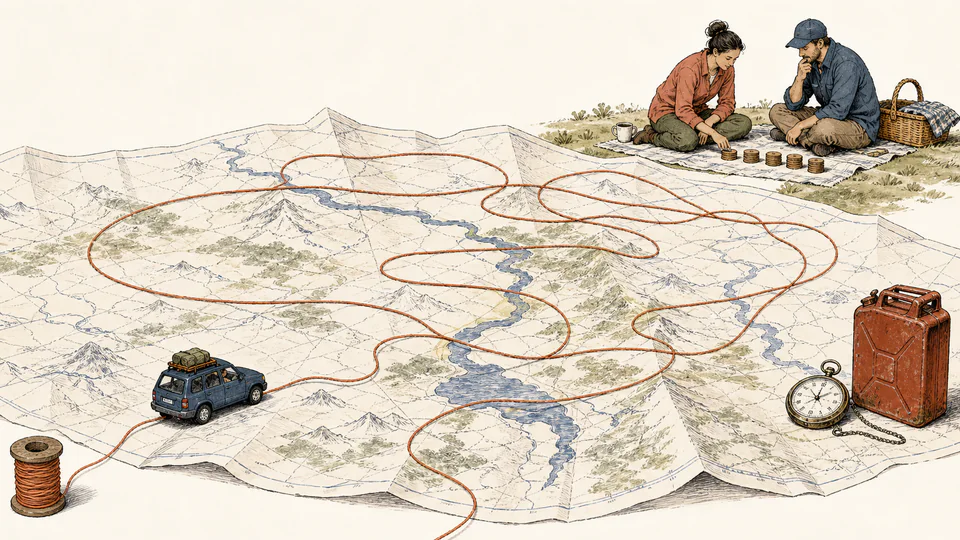
An eight-percent allowance adds more than sixty-seven miles to every default round trip.
Practical relationship planning
Convert one-way meeting distance into adjusted round trips, annual vehicle and passenger miles, fuel volume, fuel cost, and door-to-door travel hours.
DISTANCE AND MOVEMENT PLAN
A single map distance understates a repeated travel plan. This calculator applies an entered detour allowance, builds the round trip, scales it by visit frequency, distinguishes vehicle-miles from passenger-miles, and estimates fuel and travel hours. It accepts your route assumptions and does not choose a safe speed or transport mode.
DISTANCE AND MOVEMENT PLAN
Passenger-miles describe people moved; they must not be substituted for vehicle-miles when estimating fuel. Use actual route and vehicle evidence whenever available.
| Movement layer | Count / distance | Unit factor | Horizon total |
|---|
CURRENT CALCULATION PROCESS
d=2D(1+u); M=nd; Q=Mr; g=M/e; C=gp; h=n(d/v+2s)
Increase the one-way route by the entered detour rate, double it for a round trip, then scale vehicle distance by trips and passenger distance by travelers. Fuel uses vehicle-miles only; time adds two stop allowances per round trip.
| Symbol | Meaning | Unit | Default |
|---|---|---|---|
| D | One-way road distance | miles | 420 |
| u | Detour allowance | decimal | 0.08 |
| d | Adjusted round-trip distance | miles/trip | calculated |
| n | Round trips | trips | 6 |
| M | Vehicle movement | vehicle-miles | calculated |
| r | Travelers in vehicle | people | 2 |
| Q | Passenger movement | passenger-miles | calculated |
| e | Fuel efficiency | miles/gallon | 30 |
| p | Fuel price | USD/gallon | 3.60 |
| v | Average moving speed | miles/hour | 55 |
| s | Stops per leg | hours | 1.5 |
Conversions and rounding: Convert detour percent to decimal. Do not multiply fuel by traveler count. Preserve fractional miles, gallons, and hours internally; display practical decimals and money to cents.
HOW TO USE
SUBJECT FUNDAMENTALS
MODEL AND FORMULA
Increase the one-way route by the entered detour rate, double it for a round trip, then scale vehicle distance by trips and passenger distance by travelers. Fuel uses vehicle-miles only; time adds two stop allowances per round trip.
DEEPER DECISION ANALYSIS
An eight-percent allowance adds more than sixty-seven miles to every default round trip.
Two travelers double passenger-miles while the entered vehicle route stays the same.
Weather, congestion, fatigue, and legal limits determine safe actual timing; the input only estimates duration.
WORKED DECISION CASES
The default plan produces 5,443.2 vehicle-miles across six round trips before other errands.
Use this page for a road baseline, then compare quoted rail or air cash and door-to-door time on the visit-comparison page.
TECHNICAL LANGUAGE
EVIDENCE AND DATA LINEAGE
Save route screenshots with dates, odometer logs, fuel receipts, measured efficiency, stop assumptions, and traveler count. Recalculate when the destination, vehicle, season, or road conditions change materially.
LIMITS AND EXCLUSIONS
RELIABLE SOURCES
FREQUENTLY ASKED QUESTIONS
Fuel and driving time follow the actual route, so straight-line separation is not a suitable default.
Not in this simplified model; use a different efficiency input if occupancy materially changes observed efficiency.
The page is explicitly miles, mpg, and gallons; convert all quantities consistently before entry.
They are outside this fuel-distance model and belong in a visit or shared budget.
A round trip has an outbound and return leg, each receiving the entered stop allowance.
No. Follow laws, conditions, fatigue guidance, and qualified route information.
IMPORTANT NOTE
Route, stop, and speed decisions must follow current conditions, applicable law, vehicle limits, and individual health needs. This arithmetic is not navigation or safety advice.