PH

Physics calculator

Friction Equilibrium Calculator

Resolve an angled applied force on an incline, calculate normal load and required static friction, and identify equilibrium, critical slip, contact loss, or kinetic motion.

Static balance and impending motion

Is static equilibrium feasible, how much capacity remains, and which way will the body move if that capacity is exceeded?

Test a body on an incline with an applied force at a stated angle above or below the plane. The model separates tangent and normal components before comparing required friction with the maximum static capacity.

Designed for: For free-body-diagram checks where a simple mu x N calculation is not enough because the applied force also changes the normal load.

Contact state -
Normal force -
Required signed friction -
Maximum static friction -
Static capacity margin -
Predicted sliding acceleration -

LIVE MODEL OUTPUT

Resolved force balance

Every current force component, friction demand, and capacity term in the incline coordinate system.
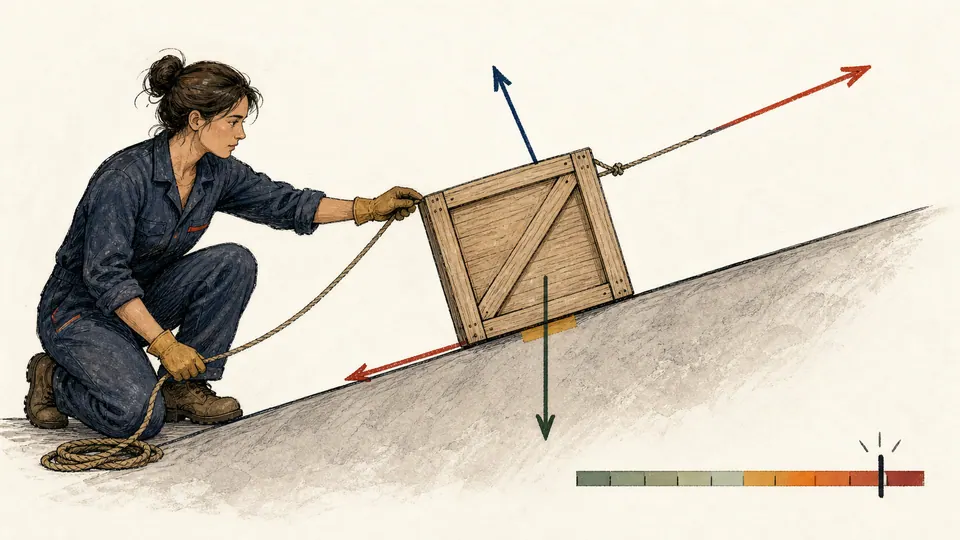
Current visualization updates with every valid input change.
Editorial illustration of a technician balancing a crate on an incline with force arrows and a highlighted contact patch.
The critical detail is often the normal-force change created by the angle of the pull.
Resolved force balanceExact values from the current model state
Every current force component, friction demand, and capacity term in the incline coordinate system.
QuantityCurrent equationValueDirection or unit

CURRENT CALCULATION PROCESS

Formula, units, substitution, intermediate quantities, and check

N = m x g x cos(theta) - P x sin(alpha); D = P x cos(alpha) - m x g x sin(theta); f_required = -D; equilibrium if |f_required| <= mu_s x N

Positive tangent is upslope and positive normal is away from the plane. The applied force is resolved before N is calculated. Static friction then takes exactly the value needed to close the tangent balance, provided that value does not exceed mu_s x N.

Symbols, meanings, units, and defaults for this page model
SymbolMeaningUnitDefault
mBody masskg40
thetaIncline angledeg18
PApplied-force magnitudeN180
alphaApplied angle above planedeg10
mu_sStatic friction coefficientunitless0.45
mu_kKinetic friction coefficientunitless0.32
NCalculated normal contact forceNderived
DTangent drive before frictionNderived

Conversions and rounding: Angles are converted to radians for trigonometric functions. All force components are in newtons. Positive required friction means friction must act upslope; a negative result means downslope.

    HOW TO USE

    Perform the equilibrium check in the right order

    1. Draw the incline axis and define upslope as positive before entering forces.
    2. Enter the applied-force magnitude and its angle relative to the plane, not relative to horizontal.
    3. Use a positive angle for a pull away from the plane and a negative angle for a push into it.
    4. Compare required friction and static capacity, then inspect the margin rather than reading mu_s x N alone.
    5. If sliding is predicted, treat the kinetic acceleration as the immediate post-slip estimate and revisit any geometry that changes with motion.

    SUBJECT FUNDAMENTALS

    What a static-friction balance actually says

    Friction is not always at its maximum
    In equilibrium, friction equals the force needed to prevent relative motion, anywhere from zero to mu_s x N.
    Normal force must be solved
    N equals the net compressive contact reaction, not automatically m x g, especially on an incline or with an angled pull.
    Impending motion sets direction
    The sign of D predicts the direction the body would move without friction; static friction acts opposite that tendency.
    Equality is a critical state
    When |f_required| = mu_s x N, equilibrium is marginal. Small disturbances or coefficient error can cause slip.
    Contact is a prerequisite
    If the outward pull makes N <= 0, the body separates from the plane and a dry-friction equilibrium is no longer defined.
    Kinetic friction is a new regime
    After slip begins, the model changes from an inequality-constrained static response to a kinetic force of magnitude mu_k x N.

    RESULT INTERPRETATION

    Turn the balance into a decision

    Positive margin

    Static equilibrium is mathematically available under the stated coefficient, but uncertainty and vibration may require additional reserve.

    Negative margin

    The sign of D identifies impending direction; kinetic acceleration uses mu_k only after the static limit is exceeded.

    Near-zero normal force

    Even before contact loss, friction capacity becomes highly sensitive to force angle and measurement error.

    DEEPER ANALYSIS

    Three checks beyond the friction ratio

    Pulling versus pushing

    A positive alpha reduces N and friction capacity; a negative alpha increases both. Two forces with the same tangential component can therefore have different slip margins.

    Margin versus utilization

    Margin is an absolute reserve in newtons. Utilization is a ratio. Both matter: a high-capacity contact can have the same utilization but a very different force reserve.

    Critical force is geometry-dependent

    The upslope critical-force expression includes alpha in both tangent drive and normal load. Dividing a tangent demand by cos(alpha) alone misses the normal-force feedback.

    WORKED CASES

    Worked balance cases

    Pulling a crate up a loading ramp

    A 40 kg crate on an 18 deg ramp pulled at 180 N and 10 deg above the plane has a reduced normal force. The page compares the remaining static capacity with the downslope balance demand and reports the actual reserve.

    Strap angle causes contact loss

    On a light fixture or panel, a steep outward strap can make P x sin(alpha) exceed m x g x cos(theta). The correct result is not zero friction; it is an invalid contact model that requires a different free-body diagram.

    ASSUMPTIONS

    Free-body assumptions

    • Rigid body treated as a particle for translation; tipping is not checked.
    • Single planar contact with uniform equivalent coefficients.
    • Applied force lies in the tangent-normal plane and has no out-of-plane component.
    • No adhesion, suction, rolling resistance, or velocity-dependent friction.
    • Static coefficients are applicable to the actual surface condition and load.

    TECHNICAL LANGUAGE

    Equilibrium terms

    Required friction
    The signed contact force needed to make the tangential force sum zero.
    Maximum static friction
    The capacity mu_s x N, not the friction force automatically present.
    Normal reaction
    The compressive contact force perpendicular to the plane after all normal components are resolved.
    Impending motion
    The direction motion would begin when the static inequality can no longer be satisfied.
    Static margin
    Maximum static capacity minus the magnitude of required friction.
    Contact loss
    A condition N <= 0 where the assumed surface can no longer supply a compressive reaction or friction.

    EVIDENCE AND DATA LINEAGE

    Evidence to retain for a balance decision

    Keep the free-body diagram, angle reference, calibrated force and mass measurements, surface condition, coefficient source, result export, and any required safety margin. A signed force list prevents later reviewers from silently changing the direction convention.

    LIMITS AND EXCLUSIONS

    Limits of the equilibrium model

    • Tipping and distributed contact pressure are not evaluated.
    • Dynamic impacts, vibration, and transient strap loads can defeat a nominal static balance.
    • Coefficients are empirical and may change with contamination, wear, temperature, and load.
    • The kinetic result is only the initial acceleration while geometry and coefficients remain constant.
    • Do not interpret exact equality as a robust safety condition.

    RELIABLE SOURCES

    Primary references and stated use

    FREQUENTLY ASKED QUESTIONS

    Questions about static hold and critical slip

    Why can required friction be negative?

    The sign reports direction. Negative required friction means the contact must act downslope to balance an excessive upslope applied component.

    Why is N smaller when I pull upward?

    The outward normal component P x sin(alpha) carries part of the load away from the plane, so the surface supplies less compression.

    What happens at exactly 100% utilization?

    The body is at the idealized static limit. Treat it as marginal because coefficient and force uncertainty can determine which side of the boundary applies.

    Does equilibrium mean the setup is safe?

    No. It only closes this translational force balance. Tipping, material strength, vibration, and required design factors remain separate.

    Why does the page reject N <= 0?

    Dry friction requires compressive contact. Once the surface cannot push on the body, the assumed contact force and friction capacity disappear.

    Can alpha be measured from horizontal?

    Not directly. Convert it to an angle relative to the incline before entry, because the component equations use the plane axes.

    IMPORTANT NOTE

    Statics and design note

    This page is an idealized force-balance aid, not a lifting, rigging, restraint, or structural certification. Use measured conditions, applicable codes, and a qualified review for consequential designs.