Physics and mechanics
Heat Transfer Energy Calculator
Calculate signed sensible and latent heat for a defined material path using Q = m c delta T and Q = m f L, without confusing total energy with heat-transfer rate.
CURRENT MODEL
Enter the declared thermal case
Laboratory, process, and education users estimating the energy absorbed or released by a known mass over a declared temperature and phase-change path.
Decision supportedSize or reconcile an energy requirement while keeping sensible temperature change separate from a declared latent phase-change contribution.
LIVE THERMAL ANALYSIS
How the current energy requirement is composed
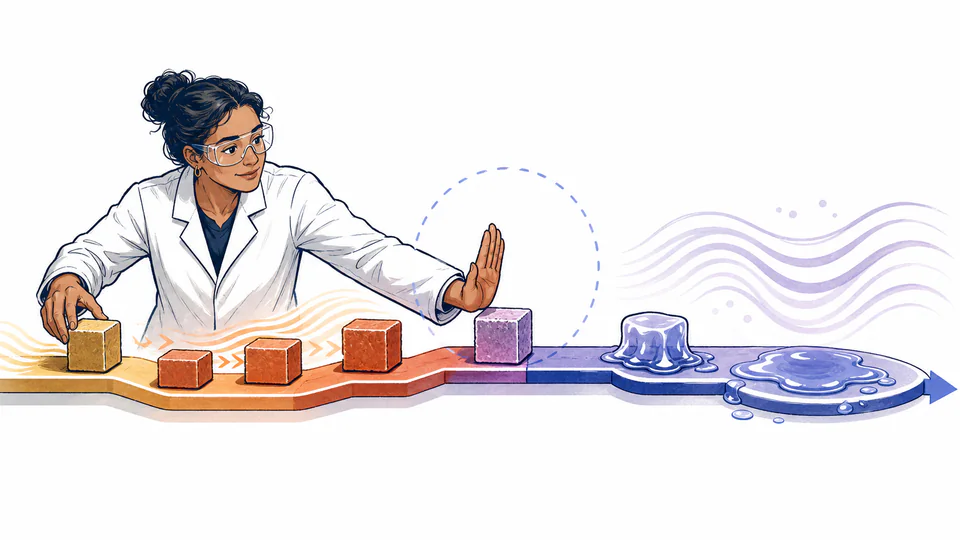
The live signed bars keep sensible and latent contributions separate; their algebraic sum equals the total energy card and ledger.
| Energy stage | Equation | Current value | Unit |
|---|
How to use
Describe one complete material path
- Enter only the mass that follows the entire declared temperature and phase path.
- Choose a specific heat for the material's current phase and the modeled temperature interval.
- Enter initial and final temperatures; their difference in deg C has the same numeric size as a kelvin interval.
- Select no phase change unless the path actually crosses and completes a known transition.
- For a transition, enter the mass fraction and a latent heat value for the correct substance, pressure, and phase pair.
- Read the signed sensible and latent rows before using the total; do not reinterpret kilojoules as kilowatts.
Energy fundamentals
Six concepts define the path
- Sensible heat
- Energy associated with a temperature change within one phase.
- Latent heat
- Energy associated with a phase change at the transition condition.
- Specific heat
- Energy per unit mass per unit temperature change.
- Heat capacity
- m c for the entered object, measured in J/K.
- Sign convention
- Energy entering the material is positive; energy leaving is negative.
- Rate distinction
- Energy is measured in joules; power requires a time basis and is measured in watts.
Calculation method
Add energy stages, not temperatures
The sensible term multiplies mass, entered specific heat, and final-minus-initial temperature. The latent term first converts the phase percentage to a decimal mass fraction and the entered kJ/kg to J/kg. Absorption uses a positive latent sign; release uses a negative sign.
This is a path ledger. If a material is heated through several phases, each sensible interval needs its own specific heat and each transition needs its own latent term; one average c cannot silently replace that sequence.
Phase-transition temperature
Latent heat belongs at the relevant transition temperature and pressure. A phase selection is invalid evidence if the entered path never reaches that condition.
Property variation
Specific heat can vary with temperature and composition. Wide intervals require tabulated integration rather than one constant average chosen for convenience.
System losses
The material energy is not automatically the heater input. Vessel heat capacity, ambient losses, reaction heat, and equipment efficiency require a larger system balance.
Signed cancellation
Opposite sensible and latent signs can algebraically cancel, but that does not mean neither transfer occurred. Preserve both ledger rows when the path is physically defensible.
Detailed calculation process
Symbols, current substitution, intermediate quantities, and reconciliation
Q_total = m c (T_final - T_initial) + s m f LThe model calculates in joules with full precision and converts to kilojoules only for presentation. Results display to 0.1 kJ and temperature differences to 0.01 K.
| Symbol | Meaning | Default | Unit |
|---|---|---|---|
| m | Material mass | 2 | kg |
| c | Specific heat capacity before melting | 2100 | J/(kg K) |
| T_initial / T_final | Temperature path | -10 / 0 | deg C |
| f | Phase-changing mass fraction | 100% = 1.0 | dimensionless |
| L | Specific latent heat | 334 | kJ/kg |
| s | Latent direction sign | +1 absorb | dimensionless |
| Q | Signed energy transferred to material | calculated | J or kJ |
Waiting for valid inputs.
Evidence and measurement
Match properties to material state
Retain material identity, composition, phase, pressure, temperature range, property-table source, and uncertainty. Mass should come from a calibrated measurement or traceable inventory. A phase fraction should come from a mass balance, quality measurement, or justified process endpoint rather than visual guesswork.
Scope and limitations
What the energy ledger omits
- Heat loss to surroundings and vessel or fixture heat capacity
- Mechanical work, chemical reaction heat, mixing, and dissolution
- Temperature-dependent c or latent heat
- Multiple sensible intervals with different phases
- Pressure-driven transition shifts and superheating or supercooling
- Transfer duration, instantaneous power, and equipment sizing
Constant entered specific heat over the sensible interval; one homogeneous mass; one declared latent transition at an appropriate phase temperature; no losses, work, reaction heat, mixing, or temperature-dependent properties.
Key terminology
Thermal-energy glossary
- Sensible energy
- Energy that changes temperature without changing phase.
- Latent energy
- Energy absorbed or released during a phase transition.
- Specific heat capacity
- Heat capacity per unit mass for a stated material condition.
- Specific latent heat
- Phase-change energy per unit mass.
- Phase fraction
- The fraction of total mass completing the declared transition.
- Heat capacity
- The object's energy change per kelvin, equal to m c here.
- Thermal path
- The ordered sequence of temperature and phase states.
- Power
- Energy transfer per unit time, measured in watts rather than joules.
Practical cases
Two paths with different evidence needs
Melting a measured ice batch
A lab heats 2 kg of ice from -10 deg C to 0 deg C and melts it. The default ledger reports 42 kJ sensible plus 668 kJ latent, totaling 710 kJ absorbed before vessel losses.
Cooling a metal charge without phase change
A process engineer selects no phase change, enters a temperature-appropriate metal heat capacity, and calculates energy released. Furnace walls, cooling gas, and radiation require a separate system balance.
Important note
Do not size a heater from total energy alone
Equipment power depends on the permitted time, rate profile, losses, control margin, and temperature limits. This page intentionally provides no watt result, because inventing a duration would mix total energy with transfer rate.
Frequently asked questions
Is this result energy or power?
It is total energy in joules or kilojoules. No duration is entered, so the calculator cannot report watts. Divide by a measured or modeled time only when the energy-transfer profile justifies an average rate.
When should latent heat be set to none?
Use none when the material remains in one phase over the full temperature interval. The sensible equation Q = m c delta T does not include energy absorbed or released at a phase transition.
Why is the default sensible heat based on ice rather than liquid water?
The default path heats ice from -10 deg C to its melting point and then melts it. The entered specific heat therefore represents the solid phase before the separate latent term is added.
Can I model partial melting or evaporation?
Yes, if the phase fraction is a defensible mass fraction and the latent heat matches that transition. The model assumes the specified fraction completes the change at the transition condition.
Why can total energy be negative?
The sign convention is energy absorbed by the material as positive. Cooling and freezing or condensation release energy, so their contributions are negative.
Does specific heat stay constant in real materials?
Not exactly. It can vary with temperature, pressure, composition, and phase. For a wide interval or a precision calculation, integrate measured c(T) data and split the path at every phase transition.
Authority and follow-on work
Reliable sources and related calculators
- OpenStax: Temperature Change and Heat CapacityDefines Q = m c delta T and the units of specific heat capacity.
- OpenStax: Phase Change and Latent HeatSeparates sensible heating from latent phase-change energy.
- NIST Guide to the SIDefines joule, watt, and specific heat capacity units.
Related calculators
Continue with a distinct heat-transfer question without silently changing the model boundary.