p

Physics and geometric optics

Mirror Rate Calculator

Convert monochromatic optical power into reflected and delivered photon rates plus the expected photons in one measurement gate.

Monochromatic photon throughput

Translate mirror power loss into an expected photon rate

Here, rate has one strict meaning: expected photons per second after mirror reflection and downstream collection. It is not optical frequency, mirror motion, or a stochastic detector count.

Delivered photon rate-
Reflected photon rate-
Expected photons per gate-
Reflected optical power-

Current model evidence

Photon-throughput ledger

Preserve the chain from photon energy to incident rate, reflected rate, delivered rate, and gate expectation.
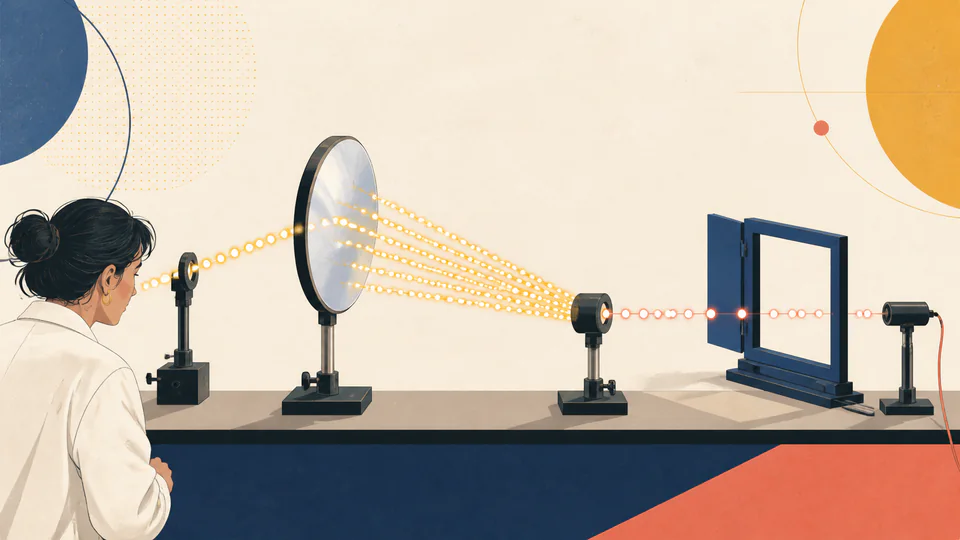
Editorial optical bench with luminous photon-like beads reflecting from a mirror and narrowing through a collection gate
Photon throughput drops at reflection and collection stages even though energy per photon remains set by wavelength.
Current photon-rate stages and gate expectationThree input-driven stages show incident, reflected, and delivered rate; the gate panel integrates only the delivered stream.
Photon-throughput ledgerCurrent unrounded calculation path
Preserve the chain from photon energy to incident rate, reflected rate, delivered rate, and gate expectation.
Throughput stagePrimary basisConverted / secondary basisCurrent valueScope / unit

DETAILED CALCULATION PROCESS

Formula, units, default substitution, and reconciliation

1. Governing relation

Egamma = h c/lambda; Ndot_inc = Pin/Egamma; Ndot_del = eta rho Ndot_inc; Ngate = Ndot_del tgate

Convert entered power and wavelength to SI, compute one photon energy from exact h and c, divide power by photon energy for the incident rate, then apply reflection and downstream throughput in sequence.

2. Symbols and default basis

SymbolMeaningUnitDefault basis
PinIncident average optical powerW2 mW = 0.002 W
lambdaVacuum wavelengthm532 nm
EgammaEnergy per photonJh c/lambda
rhoMirror reflectance10.92
etaDownstream throughput10.65
tgateMeasurement gate durations10 us

3. Unit and sign normalization

  • Millwatts are divided by 1000 before converting power to photons per second.
  • Nanometres are multiplied by 1e-9 before evaluating h c/lambda.
  • Microseconds are multiplied by 1e-6 before integrating delivered rate over the gate.

4. Current numerical substitution

    5. Independent reconciliation

    HOW TO USE THIS CALCULATOR

    Five steps from measured inputs to a defensible result

    1. Enter average monochromatic power measured at the mirror, not source nameplate power.
    2. Use the beam wavelength in vacuum; broadband light requires spectral integration outside this page.
    3. Enter reflectance for the actual coating, wavelength, incidence angle, and polarization.
    4. Bundle post-mirror collection losses into a defensible throughput fraction, documenting whether detector quantum efficiency is included.
    5. Compare delivered rate with photons per gate, then retain power calibration and loss assumptions with the export.

    MIRROR PHYSICS FOUNDATIONS

    Concepts that control this specific model

    Photon energy depends on wavelength
    Shorter wavelength gives more energy per photon, so the same wattage contains fewer photons per second.
    Optical power already is an energy rate
    Dividing joules per second by joules per photon yields photons per second.
    Reflectance reduces power and rate together
    For monochromatic light, each reflected photon has the same energy, so a power fraction is also a photon-rate fraction.
    Throughput is downstream of the mirror
    Collection aperture, relay optics, coupling, and optional detector efficiency belong after reflectance.
    Expected gate count is not an observation
    A deterministic mean does not reproduce Poisson variation, dark counts, saturation, or dead time.

    DEEP ANALYSIS 1

    Do not confuse optical frequency with event rate

    Frequency c/lambda counts field cycles per second. Photon throughput Pin/Egamma counts expected quanta crossing the path per second; the numbers have different physical meanings.

    DEEP ANALYSIS 2

    Loss placement keeps diagnosis possible

    Separating mirror reflectance from downstream throughput lets a reviewer tell whether poor delivery is caused at the coating or after reflection.

    DEEP ANALYSIS 3

    Gate length trades count for time resolution

    Expected photons scale linearly with gate duration under constant power, but a longer gate may conceal temporal structure or increase background.

    RESULT INTERPRETATION

    What the current output does and does not decide

    Delivered photon rate estimates the mean stream available after the modeled losses. It becomes a detector event rate only if throughput explicitly includes quantum efficiency and detector behavior remains linear.

    Expected photons per gate may be non-integer because it is a mean, not a rounded count from one trial.

    REAL USE CASES

    Two decisions with different boundary conditions

    Weak fluorescence relay

    A low-power 532 nm beam reflected by a 92% mirror and collected at 65% throughput can still carry trillions of photons per second; detector saturation and attenuation may dominate the next design step.

    Closed collection path

    Setting downstream throughput to zero returns zero delivered rate and gate expectation while reflected power remains nonzero, clearly locating the loss after the mirror.

    EVIDENCE AND DATA QUALITY

    What to retain with the exported result

    Retain optical power meter calibration, measurement plane, wavelength or spectrum record, coating reflectance curve, incidence geometry, collection-loss budget, gate timing, and whether detector quantum efficiency is included.

    LIMITS AND EXCLUSIONS

    Where this physical model stops

    • Assumes monochromatic steady average optical power.
    • Uses exact SI h and c but treats entered wavelength and power as exact inputs.
    • Does not simulate Poisson counting noise, pulse structure, coherence, dark counts, dead time, or saturation.
    • Treats reflectance and throughput as independent constant fractions.
    • Does not calculate eye safety, detector signal-to-noise ratio, or mirror damage.

    TERMS USED HERE

    Six terms that keep the calculation unambiguous

    Photon energy
    Energy h c/lambda assigned to one photon.
    Photon rate
    Expected number of photons crossing a stage per second.
    Reflectance
    Fraction of incident optical power in reflected paths.
    Throughput
    Fraction surviving all modeled downstream delivery losses.
    Measurement gate
    Finite interval over which expected arrivals are accumulated.
    Quantum efficiency
    Probability that an incident photon produces a counted detector event.

    RELIABLE SOURCES

    References supporting the equation and units

    FREQUENTLY ASKED QUESTIONS

    Questions specific to this calculation

    Is photon rate the same as light frequency?

    No. Light frequency counts wave cycles per second; photon rate counts expected quanta per second.

    Why can expected photons per gate be fractional?

    It is the mean across repeated gates, not a forced integer observation from one gate.

    Can incident power be zero?

    Yes. Zero power is a valid dark-input boundary and returns zero rates.

    Should detector efficiency go into throughput?

    It may, but document that choice; otherwise delivered photons describe photons at the detector entrance, not events.

    Can I use broadband white light?

    Not accurately with one wavelength. Integrate power over the spectrum because photon energy varies with wavelength.

    Does this predict shot noise?

    No. A counting-noise model would use the expected gate count as a mean and add detector-specific effects.

    IMPORTANT BOUNDARY

    Use the result as analysis, not certification

    This expected-throughput calculation is not a detector calibration, noise analysis, photon-counting certification, or optical-safety assessment.