Physics and mechanics
Sound Wave Equilibrium Calculator
Solve a steady diffuse-room acoustic energy balance from source power, equivalent absorption area, room volume, air properties, and the Sabine decay time.
CURRENT MODEL
Enter the declared physical case
Room-acoustics students, preliminary design teams, and test planners checking a room-average steady energy balance before detailed simulation or measurement.
Decision supportedEstimate whether source power and total absorption can support the intended room-average field and verify that absorbed power equals acoustic input at steady state.
LIVE PHYSICAL ANALYSIS
Source power, room reservoir, and absorbed power
The live balance distinguishes the steady energy density from the transient room volume and decay-time consequence.
| Quantity | Expression | Current value | Unit |
|---|
How to use
Assemble a room-average steady energy balance
- Enter acoustic source power delivered to the room, not electrical input power or a pressure level.
- Measure or estimate room volume and total modeled boundary area independently.
- Form an area-weighted mean absorption coefficient for the frequency band of interest.
- Use density and sound speed for the same air state.
- Read equilibrium energy density and room-average SPL as diffuse-field estimates, not seat-by-seat predictions.
- Verify that cAw/4 reproduces the source power and retain the Sabine T60 only within its stated regime.
Equilibrium fundamentals
Five concepts in a diffuse-room balance
- Steady energy
- The average stored energy no longer changes because source power equals absorbed power.
- Diffuse field
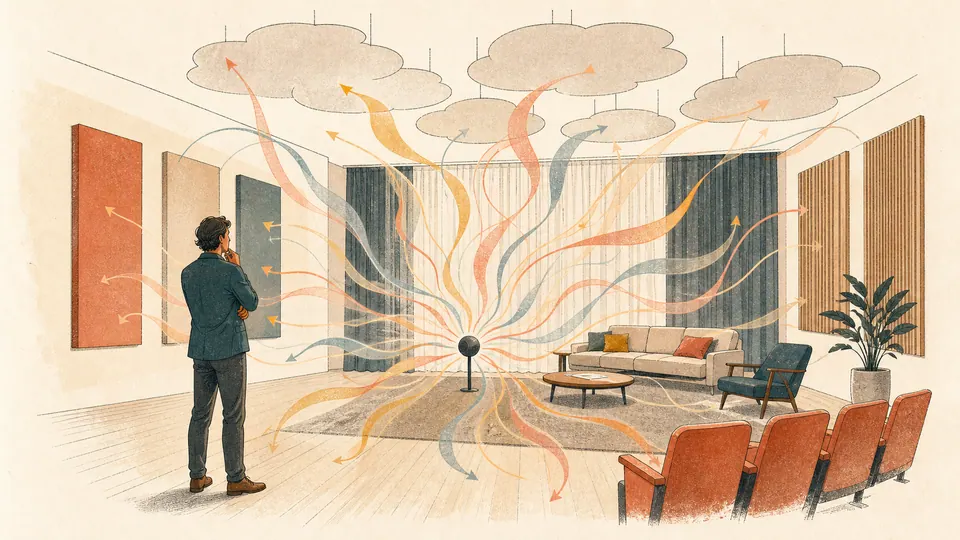
- An idealized field with energy arriving from many directions and sufficiently uniform room-average density.
- Equivalent absorption area
- The sum of surface area times absorption coefficient, expressed as square meters sabin.
- Boundary flux
- For isotropic diffuse energy, c w/4 reaches a unit boundary area on average.
- Decay time
- Room volume divided by the loss rate controls the transient approach to or departure from equilibrium.
Calculation method
Balance source power against diffuse boundary absorption
The model calculates A = alpha S, then solves W = cAw/4 for room-average acoustic energy density w. RMS pressure follows from the ideal diffuse-field energy relation, and SPL uses the 20 uPa reference.
Volume does not change this steady density for fixed power and absorption area; it changes stored energy and the energy decay constant. The final residual independently recomputes absorbed power from the solved density.
Area weighting before averaging
A small highly absorptive panel cannot be averaged equally with a large reflective wall. Calculate each S_i alpha_i contribution before dividing by total area.
Steady field versus reverberation decay
Equilibrium is a driven condition; T60 describes decay after the source stops. They share the same loss model but answer different time-domain questions.
Diffuse-field failure modes
Low-frequency modes, elongated rooms, sparse treatment, coupled spaces, and strong direct sound make local energy depart from the room-average assumption.
Detailed calculation process
Symbols, current substitution, intermediate quantities, and reconciliation
W_in = c A w/4; w_eq = 4W_in/(cA); p_rms = sqrt(rho c^2 w_eq)Energy and power balances retain full precision. SPL, equivalent area, and T60 are rounded for display only; the residual is calculated from unrounded values.
| Symbol | Meaning | Default | Unit |
|---|---|---|---|
| W_in | Acoustic source power | 0.05 | W |
| V | Room volume | 120 | m3 |
| S | Total boundary area | 150 | m2 |
| alpha | Area-weighted mean absorption | 0.25 | 1 |
| A | Equivalent absorption area | 37.5 | m2 sabin |
| w | Equilibrium acoustic energy density | calculated | J/m3 |
Waiting for valid inputs.
Evidence to retain
Document the band-specific room model
Keep room dimensions and volume survey, every surface area and absorption coefficient by frequency band, occupancy and furnishing state, source acoustic-power method, source position and directivity, air conditions, measured background level, spatial averaging method, microphone calibration, and any observed coupled-space or modal behavior.
Scope and limitations
What a room-average balance omits
- No seat-level spatial map, direct-to-reverberant ratio, source directivity, or image-source reflections
- No frequency-band aggregation or frequency dependence in absorption and air properties
- No Eyring correction for high absorption and no coupled-room exchange
- No low-frequency modal field, nonuniform diffusion, or localized treatment analysis
- No background-noise addition or multiple-source phase treatment
- No acoustic code, intelligibility, comfort, or hearing-risk determination
Equilibrium means steady room-average energy input equals boundary absorption in an ideal diffuse field. It is not zero instantaneous pressure and not modal force equilibrium. The Sabine approximation assumes sufficiently diffuse energy and absorption that is not too spatially concentrated.
Key terminology
Diffuse-equilibrium glossary
- Acoustic power
- The rate at which a source injects acoustic energy, independent of receiver distance.
- Energy density
- Acoustic energy stored per unit room volume.
- Absorption coefficient
- The fraction of incident diffuse acoustic energy absorbed by a surface in a specified band.
- Sabin
- A unit of equivalent absorption area equal to one square meter of perfectly absorbing area.
- Reverberation time
- The modeled time for sound level to decay by 60 dB after source shutoff.
- Power-balance residual
- Source power minus recomputed boundary absorption, used as a conservation check.
Practical cases
Two rooms where the same average can mislead differently
Classroom ceiling treatment
A designer increases equivalent absorption area with a band-rated ceiling and estimates the new room-average steady level and T60. The decision is screened here, then checked with octave-band prediction and post-installation measurements.
Long industrial bay
A facility team applies the balance to a narrow production bay and sees a plausible average. Because the geometry is disproportionate and machinery is directional, they flag the diffuse assumption and commission a spatial noise map before worker controls are selected.
Important note
Average equilibrium is not uniform sound
Do not use this estimate as a guaranteed microphone, seat, or worker level. Detailed room geometry, source location, frequency bands, and calibrated measurements are required when treatment contracts, speech performance, or exposure controls depend on local conditions.
Frequently asked questions
What exactly is in equilibrium on this page?
The room-average acoustic energy is steady: source power entering the field equals the time-averaged power absorbed at boundaries. Local pressure still oscillates continuously.
Why does room volume not appear in the steady energy-density formula?
For this simple balance, boundary loss is cAw/4, so steady density depends on input power and equivalent absorption area. Volume controls total stored energy and how quickly the field builds or decays.
Is the calculated SPL the level at every seat?
No. It is a diffuse-field room-average estimate. Direct sound, room modes, geometry, scattering, source directivity, and nonuniform absorption create spatial variation.
Can I average absorption coefficients without surface areas?
Not reliably. The mean coefficient must be area weighted, or calculate equivalent absorption directly as the sum of each surface area times its band-specific coefficient.
Why is zero absorption rejected?
With positive source power and no loss, this model has no finite steady energy density. Real rooms always have losses, but an input of zero would make the equilibrium formula singular.
When should I avoid the Sabine T60 estimate?
Avoid treating it as authoritative in very small rooms, highly absorptive rooms, disproportionate geometries, sparse or localized treatment, strong coupled spaces, or low-frequency modal regimes.
Authority and follow-on work
Reliable sources and related calculators
- Cornell University Building Acoustics NotesDefines absorption coefficient, equivalent absorption area, and diffuse-field assumptions.
- Purdue Herrick Laboratories: Angularly Varying AbsorptionDocuments limitations of equivalent diffuse-field coefficients in disproportionate rooms.
- Penn State: Coupled-Room Sound EnergyDescribes steady and transient acoustic energy-density behavior in coupled spaces.
Related calculators
Continue with a distinct physical question without silently changing this page's model boundary.